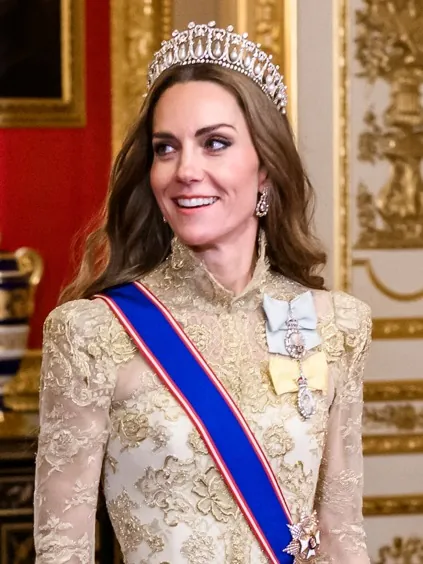
Photo: Princess Catherine in 2025; via Wikipedia.
I’m not up on royal family gossip. Although my husband does like to rip into Megan Markle. Is she considered a royal anymore? That tells you how much I follow the news. But recently, in my news feed, I saw that Catherine, Princess of Wales, aka Princess Kate, aka Kate Middleton, announced a visit to Reggio Emilia, Italy, the birthplace of the world-famous Reggio Emilia approach to early childhood education.
For many parents, hearing the term “Reggio Emilia” immediately triggers one of two reactions:
“What exactly is that?”
Or…
“I keep hearing about it, but I’m not entirely sure what makes it different.”
And honestly, that confusion makes sense.
Terms like Reggio Emilia, forest school, nature-based learning, Montessori and child-led education are suddenly everywhere in parenting conversations that discuss alternative school options in North County San Diego. Yet many families still aren’t entirely sure what these philosophies actually look like in practice.
Princess Kate’s interest in Reggio Emilia reflects something much bigger happening around the world and that is that more parents and educators are beginning to question whether modern childhood has become too rushed, too structured and too disconnected from nature.
What Is Reggio Emilia?
The Reggio Emilia approach originated after World War II in the small Italian city of Reggio Emilia.
Rather than centering education around rigid instruction and standardized outcomes for very young children, the philosophy emphasizes:
- Curiosity
- Creativity
- Relationships
- Exploration
- Collaboration
- Environment
- Child-led discovery
One of the most famous concepts in Reggio Emilia is the idea that the environment itself acts as a “third teacher.”
In other words, children don’t only learn from adults. They also learn from the spaces around them, such as:
- Natural materials
- Outdoor spaces
- Light
- Texture
- Open-ended play
- Opportunities for exploration and problem-solving
This is one reason Princess Kate’s visit has attracted attention. Her early childhood work consistently emphasizes emotional resilience, relationships and the importance of nature in childhood development.
Why Parents Are Drawn to Nature-Based Learning
Many parents intuitively feel that childhood has changed dramatically in just one generation.
For many adults, childhood once involved:
- Climbing trees
- Building forts
- Riding bikes until sunset
- Catching bugs
- Exploring creeks
- Inventing games outdoors for hours
Today, childhood often looks very different.
Children are spending more time indoors and on screens than any generation before them. While technology certainly has benefits, many parents are noticing growing concerns around:
- Over-stimulation
- Attention challenges
- Reduced physical activity
- Anxiety
- Constant entertainment-seeking
- Less independent play
That’s one reason nature-based programs and outdoor learning environments have exploded in popularity over the last decade. (I founded what is now Nature Scouts Collective in 2019.)
Research (such as this study) continues to suggest that time spent immersed in nature may help support:
- Attention and focus
- Emotional regulation
- Creativity
- Social skills
- Physical health
- Confidence and resilience
- Reduced stress levels
For many families, nature-based education feels less like a “trend” and more like a return to something children naturally need.
The Overlap Between Reggio Emilia and Nature-Based Learning
Although Reggio Emilia schools and forest schools are not the same thing, they often share important philosophical similarities.
Both approaches tend to value:
- Child-led exploration
- Hands-on learning
- Creativity over memorization
- Real-world experiences
- Emotional development
- Strong relationships
- Respect for children’s curiosity
And importantly, both approaches often recognize that children learn best when they are actively engaged with the world around them rather than passively consuming information.
At Nature Scouts Collective, we see this constantly.
Children naturally become scientists when they investigate insects.
They become engineers when they build shelters from sticks and branches.
They become storytellers when they invent games outdoors.
They become more confident when they climb, balance, problem-solve and take healthy risks in nature.
Many of these learning moments happen organically without children even realizing they are “learning.”
But What About Structure and Academics?
One criticism sometimes directed toward Reggio-inspired or nature-based programs is that they appear less structured than traditional educational environments.
And in some ways, that’s true.
Children in these environments may not always sit at desks completing worksheets or following highly rigid schedules.
But that doesn’t mean learning is absent.
In many child-led environments, literacy, math, communication and problem-solving are woven naturally into activities rather than isolated into disconnected lessons.
For example:
- Measuring sticks becomes math.
- Storytelling around nature discoveries builds literacy.
- Cooperative play strengthens communication skills.
- Navigating outdoor terrain develops spatial awareness and coordination.
Research — such as this study in Frontiers in Psychology — increasingly supports the idea that young children often learn best through movement, exploration, social interaction and sensory experiences rather than prolonged sedentary instruction.
That doesn’t mean traditional education is “bad.” Different children thrive in different environments.
But many parents are beginning to realize there may be tremendous value in giving children more opportunities for unstructured outdoor learning during early childhood.
Nature-Based Learning: An Antidote To Screens
Princess Kate’s visit to Reggio Emilia is significant not simply because of royal attention.
It matters because it reflects a broader cultural shift.
Parents across the world are asking bigger questions about childhood:
- Are children spending enough time outdoors?
- Are they developing independence?
- Are they constantly overstimulated?
- Do they have enough opportunities for free play?
- Are they learning how to interact with the real world, not just screens?
While no single educational philosophy has all the answers, the growing interest in Reggio Emilia, forest schools and nature-based learning suggests many families are searching for a healthier balance.
More parents are finally realizing that children don’t need more entertainment. They need more healthy-risk exploration (wading in a creek looking for crawdads); more movement; more curiosity, and ultimately, more time simply being children.
Nature Scouts Collective: One of North County San Diego’s Longest-Running Homeschool Enrichment Programs
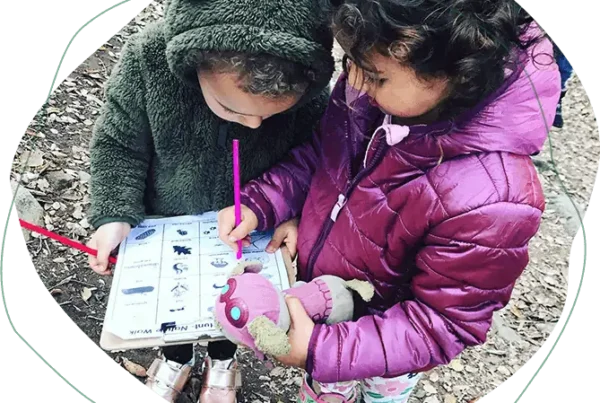
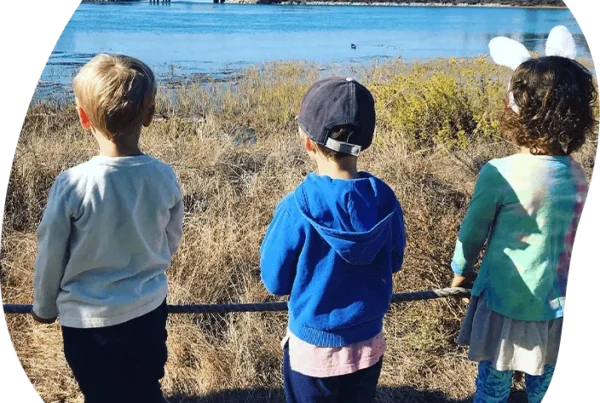
At Nature Scouts Collective, our programs provide children immersive outdoor experiences rooted in curiosity, creativity, exploration and connection with nature.
Children spend their time:
- Exploring creeks
- Observing wildlife
- Building shelters
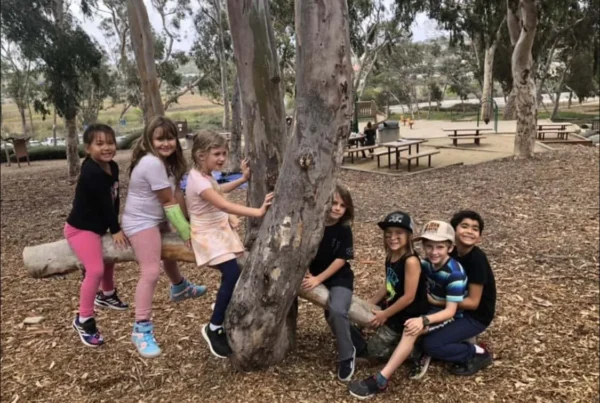
- Climbing logs
- Engaging in imaginative play
- Developing confidence outdoors….
…All while learning. I want to emphasize that nature-based learning is not a glorified play date at a park. Your child will learn “wild math” and several “ology” subjects such as Geology,
Ecology, Archaeology, Geography, Ornithology, Anthropology, and Biology.
It’s amazing what can happen when children are given space to slow down, explore and reconnect with the natural world.
It often looks a lot like the childhood many of us still remember, including mine.
Nature Scouts Collective Summer Camps Are Filling Quickly 🌲
If your child could benefit from less screen time and more green time this summer, now is one of the last chances to enroll before camps reach capacity.
Our immersive outdoor programs help children build confidence, creativity, resilience and connection through nature-based exploration and play.