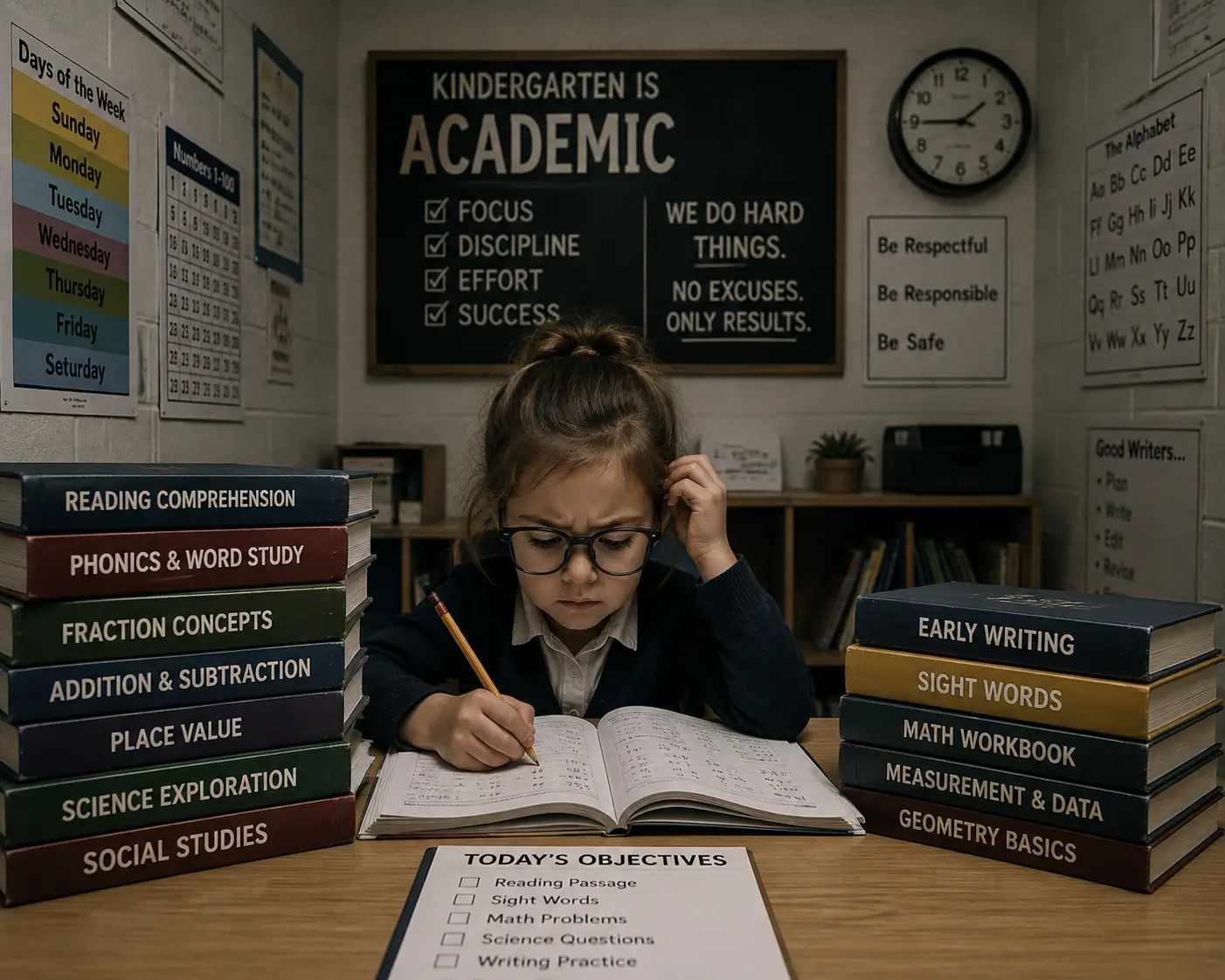
There was a time when the word kindergarten conjured images of an idyllic learning experience, complete with blocks, paint, stories, dress-up and imaginative play, and lots of playground time.
In essence, traditional kindergarten of the past involved three main components: making things. Knocking things down. And making friends, along with an ancillary lesson of conflict resolution when arguing with those friends about who gets the really good shovel in the sandbox.
Sure, fundamental learning was part of the experience but ultimately, kindergarten still looked and felt like childhood.
That balance appears to be changing.
In an August 2026 perspective published by the nonprofit education news organization EdNC, kindergarten teacher Chyenne Holloway, who is pursuing a master’s degree in reading education at North Carolina State University, describes the decline of play-based learning she has witnessed firsthand.
Her account raises an important question for parents and educators everywhere:
In our effort to make young children more academically successful, have we pushed formal academics too far, too soon?
“Bell-to-Bell Learning”
As of this writing, Holloway has taught kindergarten for four years.
She describes a schedule increasingly dictated by required blocks of literacy, reading, mathematics, science, and social studies. In her district, the resulting approach has a particularly telling name: “Bell-to-bell learning.”
According to Holloway, her kindergarten students receive a 30-minute lunch and 20-minute recess. The remainder of the day is heavily scheduled around academics.
One story from her essay illustrates just how dramatically perceptions about play have changed.
Her district had actually provided kindergarten classrooms with dramatic-play furniture because play had once been incorporated into the curriculum.
Yet Holloway says teachers could be questioned when administrators observed children playing: How did the activity satisfy academic standards?
Eventually, Holloway’s kindergarten team removed the dramatic-play furniture.
They needed the classroom space for the academic activities they were expected to teach.
Is Play Really Different From Learning?
The underlying assumption seems to be that time spent playing is time taken away from learning.
For young children, that distinction doesn’t make much sense.
Consider a child building a structure out of blocks.
The child might experiment with balance, shape, weight, symmetry, size, and cause and effect.
The tower falls. The child tries again but one block doesn’t fit. What else could work, the child wonders? The child’s friend comes over to help. Now they have to communicate, cooperate, negotiate, and perhaps resolve a disagreement.
Their teacher didn’t hand them a worksheet labeled:
Engineering + Spatial Reasoning + Problem-Solving + Social-Emotional Development
But in the hypothetical scenario, plenty of learning just happened.
Numerous studies (such as this one published in Neuroscience and Biobehavioral Reviews) have described play as important to children’s cognitive, physical, social, and emotional well-being. Its work on playful learning has also emphasized the role of play in supporting brain development, relationships, executive functioning, language, and other skills.
In other words, play isn’t what happens when children stop learning.
For young children, it is one of the ways learning happens.
Play-Based Learning: “Just Let Them Run Around?”
Supporting play-based learning doesn’t require teachers to abandon lesson plans, academic standards, or educational goals and simply turn children loose for six hours.
Play-based learning exists along a spectrum.
Sometimes, as in many Waldorf-inspired early childhood settings, children are given extended periods of largely self-directed imaginative play within an intentionally prepared environment.
Other times, an adult establishes the environment or introduces a challenge while children determine what happens next.
And sometimes a teacher deliberately incorporates an academic concept into a playful activity.
Holloway offers several examples: children can practice letter sounds by writing a menu while engaged in dramatic play, build a tower and then count its blocks, or paint an important element from a story they have read together.
The educational objective hasn’t disappeared but the way the child experiences it has.
A Classroom With No Walls
This is where play-based learning gets especially interesting to us at Nature Scouts Collective.
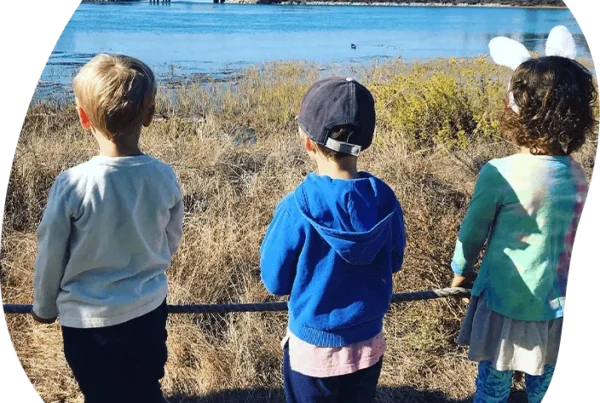
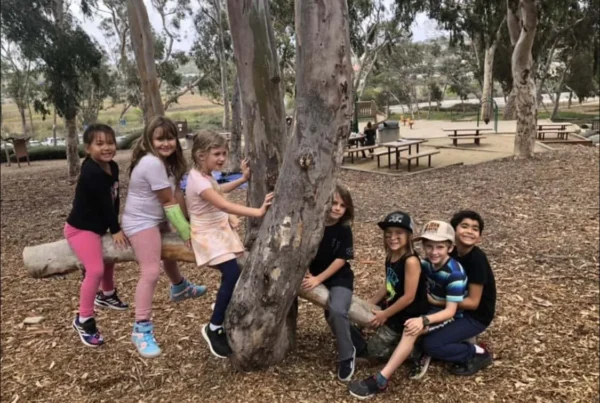
Take away the classroom walls and suddenly the number of opportunities for meaningful learning explodes.
A patch of dirt isn’t necessarily just dirt. When kids dig into it, they may encounter worms, beetles, roots, decomposing leaves, rocks, moisture, and different layers of soil.
Suddenly we’re talking about biology, ecology, botany, and geology. Or when we have a beach day at Nature Scouts Collective, a tidepool isn’t simply somewhere fun to splash around; it’s an ecosystem.
Children can observe adaptations, identify species, compare shells, examine algae, watch animal behavior, notice patterns created by tides, and begin understanding the relationship between living things and their environment.
A pile of sticks becomes a subtle lesson of geometry, stability and engineering.
A trail can become an exercise in biology, such as which animal made those tracks and why are mushrooms growing here but not over there, and why does one side of the hill stay greener and where does the water go after it rains?
These questions simply arose from the child’s interaction with the real world rather than from a page in a workbook.
Child-Led Doesn’t Mean Adult-Absent
We also think there is an important middle ground that sometimes gets lost in discussions about play.
Children benefit enormously from having room to pursue their own interests.
But adults can enrich those experiences. For instance, suppose a child finds a roly-poly. An adult could simply tell the child its name and move on. Or that discovery could become the beginning of an investigation: Where did you find it? Why do you think it was underneath the log? What happens when you touch it? Is it an insect? How many legs does it have? Why do animals curl themselves into a ball?
Now the child isn’t merely collecting facts, they’re observing, predicting, comparing, questioning, and reasoning. These are the foundational habits of scientific thinking.
As for basic reading and mathematics, play-based or nature-based education should also support these skills; they just don’t have to be learned in a seat.
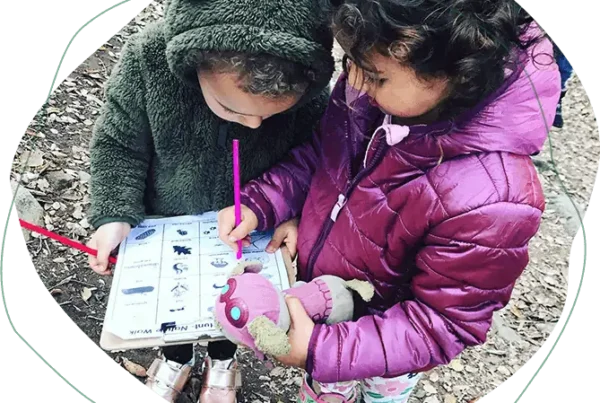
Children outside can count seeds, measure sticks, compare distances, identify patterns, estimate quantities, sort natural objects, chart observations, tell stories about what they discover, learn new vocabulary, follow written clues, label specimens, and record findings in nature journals.
A child learning the word “metamorphosis” after discovering a caterpillar has a reason to care what the word means and will better absorb it, arguably, then when learning the word on a chalkboard (or screen!).
When Play Should Just Be Play
I should add one important caveat. Not every childhood activity needs an adult standing nearby figuring out how to turn it into a standards-aligned learning objective.
Children also deserve time to invent games, chase one another, dig holes, build forts, tell ridiculous stories, climb, pretend, explore, and occasionally accomplish absolutely nothing that an adult would put on a report card.
That time has value of its own because free play gives children opportunities to negotiate relationships, deal with frustration, take manageable risks, develop independence, exercise their bodies, practice self-regulation, and use their imaginations.
Holloway’s essay isn’t an argument against education. After all, she’s an educator herself, pursuing an advanced degree in early childhood education.
But what makes her perspective so striking is that she’s describing the tension from inside the kindergarten classroom. She wants children to learn, but she also wants schools to recognize that play is one of the ways young children do it.
I couldn’t agree more.
At Nature Scouts Collective, we believe children can learn serious things without every learning experience feeling serious.
Learning and play were never opposites in the first place.
Experience Nature-Based Learning at Nature Scouts Collective
Nature Scouts Collective offers nature-based homeschool enrichment for children ages 2–11 in coastal North County San Diego. Through a combination of child-led exploration, outdoor play, hands-on academics, nature science, and guided activities, children have room to learn and room to be kids.
If you’re new to homeschool or nature-based learning and have questions, don’t hesitate to reach out. I’ve been a North County San Diego homeschool mama myself since even before 2019, when I started what would eventually become Nature Scouts Collective.