
Your child has been sitting at the kitchen table for 20 minutes.
You have reminded them what they’re supposed to be doing approximately 47 times.
Somehow the pencil needs sharpening again. There’s suddenly something fascinating underneath the table. The dog apparently requires immediate attention.
So you say the thing generations of parents have said:
“Can you please just focus?”
But what if the problem isn’t simply that your child won’t focus?
What if, at least sometimes, their ability to deliberately focus is tired?
That’s the basic idea behind Attention Restoration Theory, an influential theory in environmental psychology that may help explain why spending time in nature can leave children (as well as adults) feeling mentally refreshed (and even help relieve anxiety).
YOUR BRAIN DOESN’T PAY ATTENTION TO EVERYTHING THE SAME WAY
Imagine two situations.
In the first, a child is doing a math assignment while somebody is talking nearby. They have to concentrate on the problem, remember the instructions and deliberately ignore everything competing for their attention.
That requires directed attention.
Now put that same child on a trail.
Something rustles in the bushes. Maybe it’s a squirrel, a bird, or a snake.
They stop.
It’s a rabbit!
Nobody had to tell them to focus on the rabbit. Nobody offered a sticker for paying attention. Their attention was captured automatically.
These are very different mental experiences.
Psychologists Rachel and Stephen Kaplan developed Attention Restoration Theory around the idea that deliberately directing our attention requires effort. Keep doing it long enough and mental fatigue can set in.
When we’re mentally fatigued, concentrating may become harder. Distracting information can become more difficult to ignore. We may also become impatient or irritable.
If you’re a parent, none of this probably sounds especially theoretical.
CHILDREN & DIRECTED ATTENDING
Consider an ordinary school day from a child’s perspective.
Listen.
Wait your turn.
Ignore the conversation behind you.
Don’t stare out the window.
Remember the three instructions the teacher just gave you.
Switch subjects.
Find the correct page.
Keep working even though your friend finished already.
Then come home and do homework.
Add digital devices to the mix and another stream of highly stimulating information may be competing for their attention.
None of this means classroom learning, structured activities or technology are inherently bad.
It means attention is doing a lot of work.
Attention Restoration Theory proposes that restorative environments can temporarily change the kind of attention we’re using, giving directed attention an opportunity to recover.
WHY NATURE CAN RESTORE ATTENTION
According to ART, restorative environments tend to provide four experiences.
1. Being Away
You don’t necessarily have to travel to Yosemite.
“Being away” can simply mean experiencing enough of a mental shift that the usual demands aren’t following you.
A trail, beach, creek or grove of trees can feel psychologically different from a desk, classroom or living room.
For a child, leaving a structured indoor environment and stepping into a natural one can change the entire tone of an experience.
2. Soft Fascination
This may be the most interesting part of Attention Restoration Theory.
Nature is filled with things that capture attention without demanding it.
Watch ocean water move around a tidepool.
Follow an ant carrying something several times its size.
Listen for a woodpecker.
Look at the pattern on a shell.
Notice which way the clouds are moving.
Psychologists call this soft fascination.
Compare that with the intense, effortful concentration required to solve a difficult problem or the high-intensity stimulation of a fast-moving digital game.
Nature can occupy the mind without continually asking it to exert control over where its attention goes.
In ART, that’s important: while involuntary attention is pleasantly engaged, directed attention may be given some breathing room.
3. Extent
A restorative environment also needs enough richness and coherence to feel like somewhere you can mentally enter and explore.
Nature is particularly good at this.
A woodland isn’t a single stimulus. Neither is a beach, lagoon or coastal trail.
Look in one direction and there are birds. Look down and there are tracks, rocks and plants. Walk 20 feet and the scene changes again.
There is always a little more to investigate.
4. Compatibility
Finally, an environment needs to fit what the person wants or needs to do.
A child who loves climbing, collecting, exploring, sketching, investigating animals or asking questions may find an outdoor setting naturally compatible with those impulses.
This is one reason child-led learning and nature can complement each other so well.
The environment keeps offering possibilities.
RESEARCH ON “ART” – ATTENTION RESTORATION THERAPY
One study followed 2,593 children ages 7 to 10 attending 36 schools in Barcelona. Greater greenery within and surrounding schools was associated over 12 months with better progress in working memory and superior working memory and greater reductions in inattentiveness.
Another experiment looked at 17 children ages 7 to 12 with ADHD. Each child took separate 20-minute walks through a park, a residential neighborhood and a downtown area. Their concentration scores were significantly better following the park walk than after the other two walks.
WHAT ABOUT CHILDREN WHO DON’T HAVE ADHD?
You don’t need a diagnosis for your attention to become fatigued.
That’s a particularly important point for parents.
Sometimes conversations about nature and attention focus so heavily on ADHD that nature starts sounding like a specialized intervention for children with a disorder.
It isn’t.
Every child uses directed attention.
A typically developing child can still have a mentally demanding morning at school. They can still become overloaded by instructions, screens, noise and transitions. They can still reach a point at which focusing becomes harder than it was two hours earlier.
Nature doesn’t need to “treat” anything to be valuable.
Providing children with restorative experiences before attention problems become severe is a little like making sure they sleep before they’re exhausted or eat before they’re ravenous.
We don’t have to wait for something to be wrong.
HOW NATURE SCOUTS COLLECTIVE SUPPORTS ATTENTION RESTORATION
At Nature Scouts Collective, we don’t take children outdoors simply because fresh air is nice.
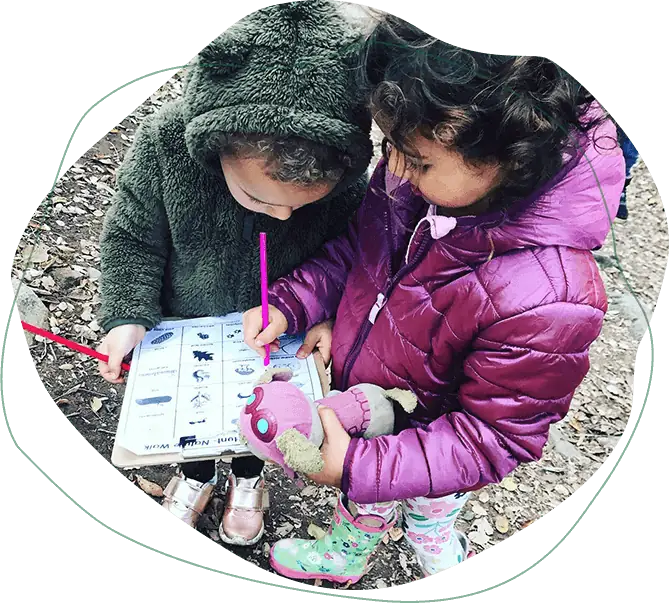
Our programs give children opportunities to move, explore, investigate, ask questions, journal, participate in STEM activities, hike through different habitats and follow discoveries that can’t always be scheduled in advance.
Some moments are teacher-guided while others begin because a child notices something.
For families looking for homeschool enrichment or simply more meaningful time outdoors, our North County San Diego programs give children something increasingly scarce in modern childhood: time and space for their attention to work differently.
Your child doesn’t have to stop learning in order to give their brain a break from constantly forcing itself to pay attention.
Sometimes the best place to restore attention may also be one of the best places to use it (the outdoors).
Give Your Child More Opportunities to Learn in Nature
Nature Scouts Collective provides immersive outdoor enrichment experiences for children ages 2–11 throughout North County San Diego. Through nature science, exploration, movement, STEM activities, journaling and child-led discovery, children get to experience education beyond four walls.
Explore our programs and find the Nature Scouts experience that’s right for your family.