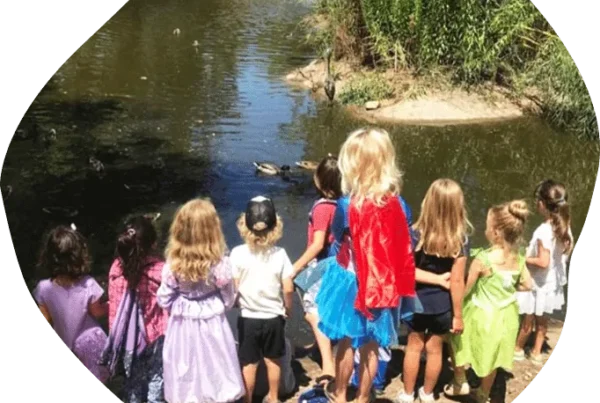
There’s a lot to love about homeschool park meetups. Children get fresh air, enjoy some unstructured play, and spend time with other kids, while parents have opportunities to connect with like-minded families.
But occasionally getting together outdoors isn’t quite the same as regularly sharing experiences that encourage children to learn, collaborate, and develop meaningful friendships.
For families who homeschool or embrace the philosophy of unschooling, children can have their cake and eat it too; they can have the freedom to direct their own learning within a consistent community of peers and experienced educators.
(Finding the rare program that does just that is one click away.)
Unschooling: When Curiosity Becomes the Curriculum
Unschooling is a form of home education that allows children’s interests, questions, and experiences to guide their learning rather than following a prescribed curriculum or sequence of academic lessons.
The philosophy doesn’t necessarily outright reject education or academic development. Instead, it challenges the assumption that meaningful learning must always be organized into separate subjects, scheduled lessons, and formal assessments.
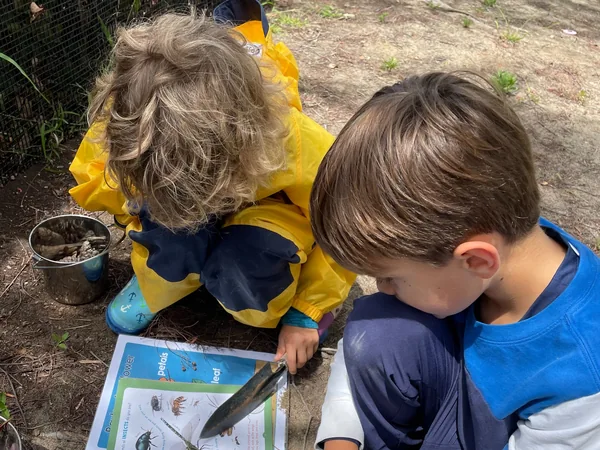
Consider a child fascinated by a creek. What begins as a simple interest in finding tadpoles might lead to questions about amphibian development, water quality, seasonal changes, and the surrounding ecosystem. Reading identification guides, recording observations, measuring water depth, and comparing findings can incorporate literacy, mathematics, and scientific reasoning without a conventional classroom lesson.
The learning has a purpose because the child has a genuine reason to investigate.
This is an important distinction between unschooling and simply leaving children to entertain themselves. Adults can provide resources, answer questions, introduce opportunities, and support children’s discoveries without controlling every step of the educational process.
What Does Research Say About Unschooling?
In 2013, researchers Peter Gray of Boston College and Gina Riley of Hunter College published a study involving 232 unschooling families in the Journal of Unschooling and Alternative Learning.
The researchers asked families about their reasons for choosing unschooling, their educational practices, and the benefits and challenges they experienced.
Parents frequently described improvements in their children’s attitudes toward learning, greater independence, and positive psychological and social experiences. Families also reported greater flexibility and opportunities for children to pursue subjects that genuinely interested them.
The findings were encouraging, although the researchers relied on self-reported experiences from families who had voluntarily chosen unschooling.
In a 2015 follow-up study, Gray and Riley surveyed 75 adults who had experienced unschooling during at least the equivalent of their final two years of high school.
Most respondents viewed their experiences positively, particularly the freedom to pursue personal interests and develop self-direction. Many also described satisfying social lives, including friendships with people of different ages.
However, some participants reported gaps in their education, and a small number described social isolation.
That last finding raises an important consideration for unschooling families: Freedom to learn independently doesn’t eliminate children’s need for meaningful relationships and community.
Why Consistency Matters for Childhood Friendships
A semi-regular homeschool meetup can be a wonderful opportunity for socialization. But when children regularly spend extended periods together, exploring familiar places, solving problems, and sharing experiences, those friendships have more opportunities to develop beyond the initial introductions and casual play.
Children begin remembering one another’s interests, developing shared routines, and building trust through repeated interactions. They have time to discover who enjoys similar activities, negotiate disagreements, and practice the cooperation that healthy friendships require.
Of course, some informal homeschool groups develop exceptionally close communities. Frequency alone doesn’t guarantee friendship, either.
Still, consistent participation creates opportunities for relationships to develop naturally, especially when children are engaged in meaningful activities together.
And nature provides an extraordinary setting for those shared experiences.
What Forest School Research Reveals About Cooperation
A study published in the Journal of Adventure Education and Outdoor Learning examined the effects of regular Forest School participation on children ages 7–8.
Researchers from the University of East London compared children who attended 12 weekly Forest School sessions with peers who continued their usual classroom activities. The final sample included 151 children.
The study, published in 2025, found that Forest School participants reported feeling calmer, happier, less bored, and less tired than children in the comparison group.
Perhaps most relevant to homeschool and unschool families, the researchers also observed greater improvements in cooperation among children who attended Forest School.
During collaborative activities, children had to communicate, share responsibilities, consider one another’s ideas, and work toward common goals.
The results provide evidence that regular outdoor learning experiences can support cooperative behavior.
Those experiences are important because friendship involves more than simply being around other children. It requires opportunities to communicate, negotiate, cooperate, and build trust.
Beyond the Playdate: Nature as a Place for Deeper Learning
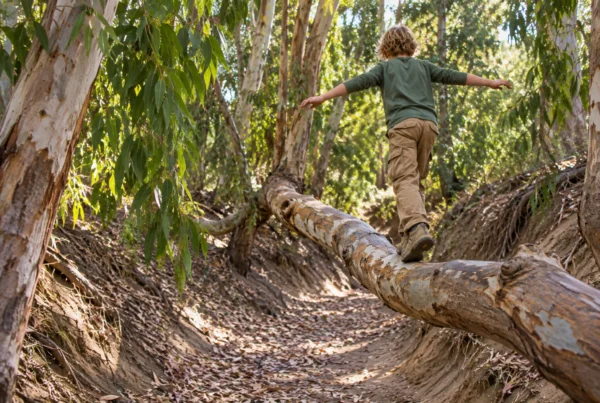
Unstructured outdoor play has enormous value in its own right. Children need opportunities to invent games, explore independently, take appropriate risks, and enjoy one another’s company without adults directing every activity.
But a sustained nature-based learning experience can build upon that freedom.
Imagine several children discovering unusual tracks along a muddy trail. An experienced nature educator might encourage them to examine the tracks more closely, compare their shapes, consider what animals live nearby, and investigate where the tracks lead.
One child might sketch the footprints while another searches for additional clues. Others might propose competing explanations about which animal passed through and when.
What began as a spontaneous discovery becomes a shared investigation involving observation, reasoning, communication, and collaboration.
The educator doesn’t need to supply all the answers. Sometimes the most valuable contribution is asking a question that encourages children to investigate further.
And when those children return the following week, they can revisit the same location, compare their findings, and continue exploring questions that remain unanswered.
The experience has continuity, both educationally and socially.
Where Nature Scouts Collective Fits In
At Nature Scouts Collective, we embrace many of the principles that make unschooling appealing to families: curiosity-driven exploration, experiential learning, independence, and the freedom to discover through firsthand experience.
Our outdoor enrichment programs in North County San Diego give children opportunities to learn alongside familiar peers, guided by experienced educators who understand the value of following children’s interests while encouraging deeper investigation.
For our older Junior Scouts, ages 7–11, that includes hands-on science, STEAM projects, nature journaling, navigation, outdoor skills, collaborative problem-solving, and environmental stewardship.
These experiences allow children to apply academic and critical-thinking skills in meaningful ways while developing confidence and independence.
Just as importantly, regularly spending time together gives children opportunities to form friendships through shared discoveries, challenges, and adventures.
We don’t believe children have to choose between the freedom of child-led exploration and the benefits of an intentional educational program.
Nor do homeschool and unschool families need to choose between informal playdates and more structured enrichment experiences. Both can contribute to a rich and rewarding childhood.
But there’s something special about returning to the same community of children, watching their interests develop, and seeing how much they can discover together.
A Community Where Curiosity and Friendships Grow
For families interested in unschooling, homeschooling, or simply providing a different kind of educational experience, nature-based learning offers an opportunity to combine independent discovery with meaningful social connections.
At Nature Scouts Collective, the goal is to create an environment where children can pursue their interests, collaborate with peers, develop practical skills, and discover what they’re capable of accomplishing.
Because a childhood filled with meaningful learning experiences is wonderful.
And having friends to share those experiences with makes it even better.
Explore Nature Scouts Collective’s Outdoor Enrichment Programs
Discover how our immersive nature classes bring curiosity, learning, and community together for homeschool and unschool families in North County San Diego.