Parents are naturally inclined to protect their children from injury, but researchers studying childhood development have increasingly questioned whether eliminating too much uncertainty from play may come with its own costs.
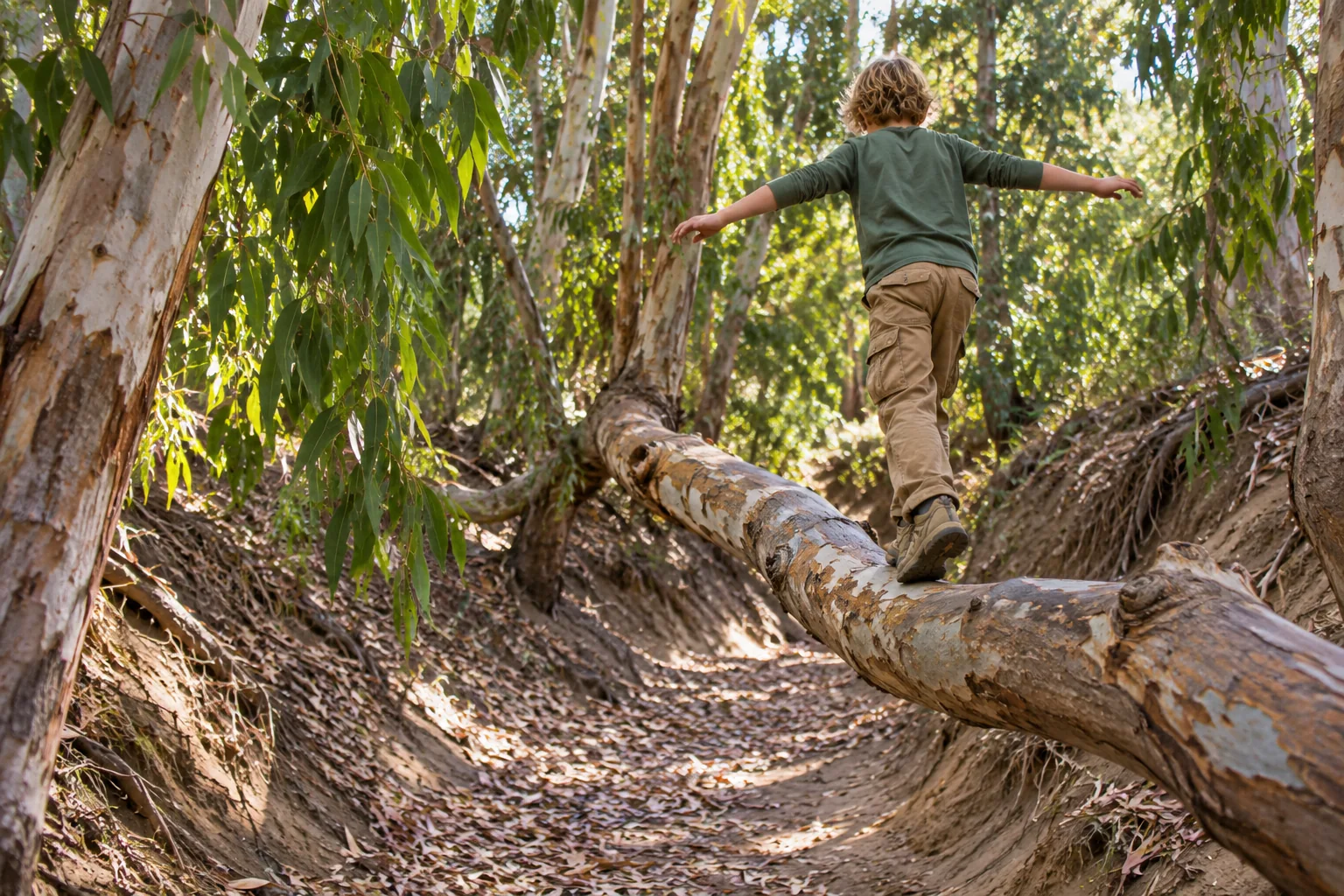
Activities such as climbing trees, balancing on logs, navigating uneven terrain, moving quickly, exploring unfamiliar environments and testing physical limits all involve some degree of risk, yet they also give children opportunities to evaluate situations, make decisions and learn what their bodies can safely do.
Researchers generally describe these experiences as risky play, meaning forms of play that involve uncertainty and the possibility of physical injury while remaining within a child’s ability to recognize and evaluate the challenge.
A review published in PLOS ONE in October 2026 provides one of the most comprehensive examinations to date of how outdoor risky play may affect children.
Researchers analyzed 74 studies involving children ages 3 to 12. The research examined physical health, mental health and well-being, social development, cognitive development, aggression, risk competence and injuries.
Overall, general risky play and environments designed to support it were associated with positive outcomes across physical, mental, social, cognitive and risk-competence measures.
What 10+ Years of Research Say About Risky Play
The 2026 review represents a substantial expansion of the evidence available just over a decade ago. A previous review published in 2015 identified only 18 eligible studies and found positive associations between risky outdoor play and outcomes including physical activity and social competence. That earlier research also suggested that children with greater freedom to move independently tended to be more physically active and less sedentary, while environments that permitted more adventurous play appeared to encourage longer periods of play, greater creativity, improved social interactions and resilience.
By 2026, the research base had roughly tripled, allowing investigators to distinguish among different kinds of risky play rather than treating them as one broad category. The new review examined general risky play, environments that encourage risky play, independent mobility and rough-and-tumble play separately.
Risky Play and Physical Activity
The clearest finding involved children’s physical activity, particularly when they were given greater freedom to move independently. Among the 25 studies examining physical health outcomes, 23 measured some aspect of physical activity, including steps, sedentary time and light, moderate or vigorous activity. Most studies examining independent mobility found that children who were permitted greater freedom to travel and explore were also more physically active, and studies examining active transportation found that children with greater independence engaged in more walking and other active travel.
Research also documented the wide variety of movement that occurs in environments supporting adventurous play. Researchers observed children climbing, jumping, running, swinging, wrestling, carrying materials and navigating natural environments, while parents and educators reported improvements in areas such as balance, coordination, movement skills, strength and cardiovascular fitness.
The strongest conclusion from the evidence was that greater freedom of movement is consistently associated with greater physical activity.
Mental Health, Confidence and Self-Regulation
The research on psychological outcomes is particularly relevant to parents because risky play may provide opportunities for children to experience manageable fear, overcome challenges and develop confidence in their own abilities.
Thirteen studies in the 2026 review examined mental health and well-being. Research on general risky play found associations with greater well-being, more positive emotional states, fewer internalizing problems, stronger self-control and higher self-esteem. Studies of environments designed to support risky play also reported positive outcomes, including better overall mental health and greater happiness at school.
Risky Play: “Fun, Exciting and Enjoyable” For Kids
Children frequently described risky outdoor play as fun, exciting and enjoyable, while parents, teachers and researchers reported increased confidence, self-belief and task-specific self-efficacy. Across the broader evidence base, outdoor risky play was positively associated with measures and observations involving self-confidence, resilience, emotional regulation and children’s belief in their own abilities.
These findings are particularly interesting because some of the psychological benefit may come from the uncertainty itself. Successfully climbing a little higher, finding a way across difficult terrain or attempting something that initially seems intimidating gives children direct evidence that they can evaluate a challenge and respond to it. Confidence developed through those experiences differs from reassurance supplied entirely by an adult because the child participates in producing the successful outcome.
Social Development and Learning to Negotiate With Others
Outdoor play that contains some degree of uncertainty also creates social situations children must negotiate themselves. A group building a structure from sticks, navigating a trail or deciding how to use a fallen tree has to communicate, compromise, establish informal rules and adjust to the abilities and comfort levels of other children.
The 2026 review identified 16 quantitative studies examining social outcomes, along with additional qualitative evidence. Findings varied considerably depending on the type of play studied, particularly for rough-and-tumble play, but supportive outdoor environments were associated in qualitative studies with cooperation, social interaction and children’s ability to negotiate play with one another.
Some research also suggested that giving children more control over their play environment may reduce rather than increase certain social problems. In one New Zealand school studied after introducing loose materials into its play environment, educators reported less conflict and bullying and a reduced need for teachers to intervene during recess.
Risky Play’s Impact On Cognitive Development
Compared with physical activity and mental health, the evidence concerning cognitive development remains relatively limited. Only five studies in the review directly measured cognitive outcomes.
Although more limited, the evidence points toward several potentially important cognitive processes. Natural environments repeatedly require children to solve practical problems, make predictions, evaluate changing conditions and adapt their behavior. A child climbing a tree must determine where to place a hand or foot, judge whether a branch can support weight and continually revise those decisions as the climb progresses. A child crossing uneven terrain has to evaluate distance, balance and stability in real time.
The review’s authors specifically identified problem-solving, creative thinking and executive function under uncertainty as promising areas for future research because these abilities are conceptually connected to the decisions children make during risky play.
One example described in the research illustrates how physical exploration and academic learning can intersect naturally. During an Australian outdoor kindergarten program, an educator asked a child why objects fall from trees. The resulting conversation moved from the child’s experience of falling while climbing to a discussion of gravity and what she had learned about holding on securely. The physical experience became an entry point for scientific reasoning rather than an interruption of learning.
Learning How to Assess Risk
Perhaps the most distinctive potential benefit of risky play is risk competence, which refers to children’s developing ability to identify, evaluate and respond to uncertainty.
Researchers describe risk competence as involving several related skills, including willingness to encounter an appropriate challenge, the ability to assess what makes a situation risky and the ability to handle that risk once a decision has been made. Research repeatedly documented children modifying their behavior based on experience, developing better awareness of their physical capabilities and learning how to respond to increasingly difficult situations.
Importantly, children do not perceive the same activity as equally risky. One child may climb easily to the top of a tree while another experiences a sense of uncertainty simply standing on the lowest branch. Appropriate risky play therefore cannot be defined solely by the height of a tree, speed of a bicycle or difficulty of a trail. The child’s developmental level, experience, confidence and perception of the challenge all influence the amount of risk involved.
What About Injuries?
Any discussion of risky play needs to address the concern that allowing more risk might lead to more injuries.
The evidence is not sufficient to provide a simple answer. One quantitative study found that children who participated in a wider variety of risky play experienced more injuries than children exposed to fewer types of risky play. However, the relationship was moderated by self-control: greater risky-play exposure had relatively little association with injury among children with higher levels of self-control.
Studies frequently described injuries associated with adventurous play as minor, and the review found positive associations between environments supporting risky play and the development of risk competence. Researchers have proposed that experiencing manageable consequences, including occasional minor scrapes or falls, may help children improve their ability to assess risk and potentially avoid more serious injuries later.
What Parents Should Take From the Research
The 2026 review offers substantial support for allowing children greater opportunities for outdoor exploration. General risky play and environments that support it were positively associated with physical activity, mental health and well-being, social development, cognitive outcomes and risk competence, while independent mobility showed particularly strong evidence for increased physical activity. The findings make the case for reconsidering the assumption that the healthiest childhood environment is necessarily the one from which adults have removed as much uncertainty as possible.
Nature-Based Education And Risky Play
Nature provides an unusually rich environment for developmentally appropriate challenge because it is variable in ways that classrooms and conventional playgrounds often are not. Trails change elevation, logs require balance, rocks differ in stability, plants invite examination and unfamiliar habitats present children with questions that cannot always be answered before the experience begins.
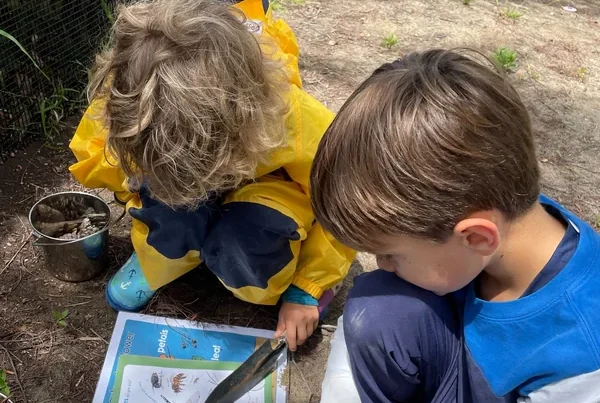
Those same environments also provide opportunities for academic learning. A child investigating a habitat can read about the species that live there, record observations in a nature journal, measure and compare natural objects, develop scientific hypotheses, learn new vocabulary and communicate conclusions to teachers and peers. Rather than treating physical exploration, independence and academics as separate parts of childhood, nature-based education can combine them within the same experience.
Learning, Independence and Nature at Nature Scouts Collective
At Nature Scouts Collective, children spend extended time learning in the natural environments of North County San Diego, where academic enrichment is combined with movement, exploration and age-appropriate independence.
Nature Scouts kids are not simply gathering outdoors for unstructured social time; they participate in educator-guided experiences that incorporate science, literacy, nature journaling, observation, measurement, project-based learning and critical thinking while still allowing room for children to explore and solve problems for themselves.
For homeschool families in particular, this provides an alternative to choosing between academic enrichment and the developmental benefits of outdoor childhood. Children can strengthen reading, writing, science and communication skills while also learning how to navigate a trail, evaluate an appropriate physical challenge, cooperate with other children and develop greater confidence in their own judgment.
Explore Nature Scouts Collective programs and discover how being immersed in nature can support both academic learning and the independence children develop by doing more for themselves.