Smartphones may play a more significant role in children’s sleep than the televisions and computers that dominated earlier generations of screen use.
A 2026 study published in Humanities and Social Sciences Communications followed 2,607 children in South Korea from fourth through eighth grade. Researchers examined how their nightly sleep changed over five years and whether those patterns were associated with smartphone, computer, and television use.
The clearest finding was not simply that “screens are bad.”
It was that the type of screen may have a more deleterious impact on sleep quantity (to say nothing of sleep quality).
Smartphone use showed the strongest association with shorter sleep-duration trajectories, while television and computer use showed comparatively weaker relationships.
Every Group Slept Less Over Time
The researchers identified three sleep patterns:
- A high-decreasing group, representing 16.7% of the children
- A mid-decreasing group, representing 78.2%
- A low-decreasing group, representing 5.1%
The names sound technical, but the central idea is straightforward: every group slept less as the children moved from fourth to eighth grade.
The difference was where they began and how far their sleep declined.
The highest-sleep group averaged approximately 9.8 hours in fourth grade and 8.1 hours by eighth grade. The largest group began at about 9.1 hours and declined to approximately 7.6 hours. The smallest and most vulnerable group began at roughly 8.3 hours and fell to about 6.6 hours by eighth grade.
All three groups charted downward as the children grew older, with the shortest-sleeping group remaining well below the others throughout the study.
That means inadequate sleep was not only an issue for a handful of children who suddenly developed poor habits in adolescence. Some were already sleeping less in elementary school and continued losing sleep from there.
Smartphones Stood Out From Other Screens
Earlier research from 2010 involving Korean fourth graders found that television and computer use were the screen-related activities most closely connected with sleep patterns. Smartphone use played a relatively minor role.
But within only a decade or so, the digital environment had changed.
The fourth graders in the newer study had grown up in a world of widespread smartphone ownership, social media, streaming, mobile gaming, and constant internet access. In that environment, smartphone use emerged as the strongest screen-related factor associated with shorter sleep.
At the beginning of the study, higher smartphone use was associated with greater odds of belonging to both the middle- and low-sleep groups. Children who used smartphones more were also more likely to belong to the lowest-sleep group rather than the middle group.
Television viewing, by contrast, was not significantly associated with those initial sleep-trajectory classifications.
Families are often advised to reduce “screen time” as though every digital activity were interchangeable. But 30 minutes watching a television program with the family may not affect a child in the same way as 30 minutes scrolling through messages and videos alone in bed.
Why Are Smartphones So Difficult to Put Down?
The study did not experimentally test the exact mechanisms responsible for the relationship. However, the researchers identified several smartphone features that may make these devices particularly disruptive.
Smartphones Are Portable
A television usually remains in a shared room. A desktop computer stays on a desk.
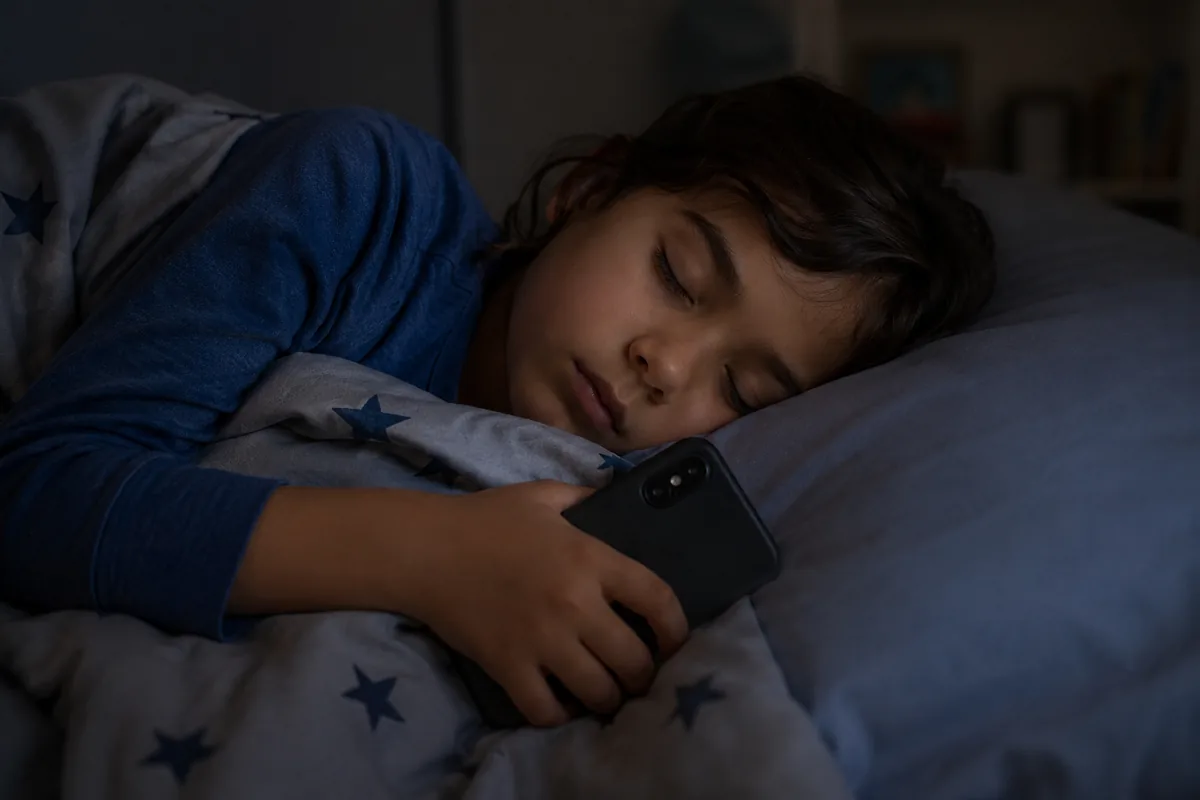
A smartphone can be carried into the bedroom, placed beside the pillow, and checked repeatedly after bedtime. Even when parents believe screen time has ended, the device may still be within reach.
Smartphone Content Does Not Naturally End
Traditional television programming has a stopping point. The show ends and the TV is shut off eventually.
Smartphone platforms, however, are often designed around continuous engagement. One video leads to another. A message produces a reply. A game offers another round. A social feed keeps refreshing.
There is rarely a clear signal that says, “You are finished now.”
Smartphones Are Social
Putting down a phone may feel more difficult than turning off a television because the child is not only leaving entertainment. They may feel as though they are leaving a conversation, missing an update, or becoming disconnected from friends.
That social pull can create an additional psychological barrier between the child and sleep.
Smartphones Can Replace Other Activities
By the final year of the study, smartphone and computer use had increased while television viewing declined. The researchers suggested that less television was not necessarily protective because children may simply have replaced it with smartphones, computers, studying, or other activities that delayed sleep.
The lesson is not that television is healthy and smartphones are harmful in every circumstance. It is that technology use changes and family boundaries need to change with it.
Academic Pressure on Sleep Patterns
Smartphone use was not the only factor associated with shorter sleep.
Children who spent more time in private tutoring were also more likely to belong to the lowest-sleep group. The researchers emphasized that the combination of academic demands and smartphone use may create an especially difficult environment for healthy sleep.
A child may finish school, attend tutoring, complete assignments, and then turn to a smartphone for relaxation or social connection. The phone may be the first opportunity the child has had all day to do something self-directed.
Telling that child to “just put it down” overlooks the larger structure of the day.
This portion of the study reflects the particularly intensive academic culture of South Korea, so the findings should not be applied uncritically to every American family. Still, the underlying tension will feel familiar to many parents: schoolwork expands, extracurricular commitments accumulate, free time moves later into the evening, and sleep absorbs the loss.
What Can Families Do?
The researchers recommended addressing smartphone use specifically rather than relying only on broad screen-time rules.
Potential strategies include:
- Keeping phones outside the bedroom overnight
- Establishing a shared family charging location
- Activating nighttime or downtime settings automatically
- Creating a parent-child agreement about evening phone use
- Discussing why sleep boundaries exist rather than presenting them only as punishment
- Reviewing whether homework, tutoring, sports, and other commitments leave enough time for both relaxation and sleep
A rule is more likely to work when it is practical, predictable, and modeled by adults.
“Phones stay in the kitchen after 8:30” is clearer than “Don’t spend too much time on your phone.” It is also easier to enforce consistently.
But restrictions are only part of the answer.
Children Need Something Better Than the Screen
It is easy to talk about what children should do less of, whereas the harder and more useful question is what will fill the space.
Children need experiences compelling enough to compete with digital entertainment. They need movement that feels like play rather than prescribed exercise. They need time with friends that does not depend on group chats. They need physical materials they can manipulate, environments they can explore, and problems without predetermined answers.
That is one reason outdoor learning and nature-immersion enrichment programs have become increasingly valuable.
The Real World Still Has Something to Offer
At Nature Scouts Collective, children do not spend the day being told to avoid screens.
They do, however, get busy doing something else.
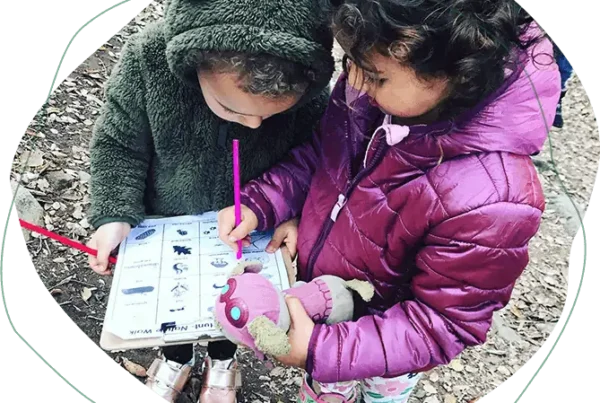
They hike, build, dig, observe, invent, cooperate, take appropriate risks, solve disagreements, and follow their curiosity. Nature provides movement without a workout video, sensory stimulation without an algorithm, and social connection without a notification.
By the time a child becomes deeply engaged in constructing a shelter, following animal tracks, searching a tide pool, or developing an elaborate game with friends, the phone is no longer the most interesting object available.
That is the opportunity adults can provide: not merely a childhood with fewer screens, but one with more life beyond them.
Sleep Habits Begin Before Adolescence
Perhaps the most important lesson from the study is that sleep patterns were already diverging in fourth grade.
The children who slept the least in eighth grade had also slept the least when the study began. Their disadvantage did not suddenly appear in middle school.
That suggests families should not wait until nightly phone battles are firmly established.
Healthy habits can begin while children are still young:
- Bedrooms can remain device-free.
- Outdoor activity can be part of the weekly routine.
- Unstructured time can be protected.
- Sleep can be treated as a biological need rather than leftover time.
- Children can learn that boredom does not always require a screen-based solution.
No single strategy will eliminate every bedtime struggle. Children have different temperaments, responsibilities, and developmental needs.
But childhood routines become childhood habits—and childhood habits have a way of following children into adolescence.
Give Childhood More Room Beyond the Screen
Smartphones will remain part of how children learn, communicate, and participate in modern life.
The goal is not to raise children who never use technology.
The goal is to keep technology from occupying every available corner of childhood, including the hours children need to sleep.
Nature Scouts Collective gives homeschool children in coastal North County San Diego regular opportunities to move, explore, create, and connect outdoors. Our programs provide a meaningful counterweight to increasingly screen-centered routines while supporting curiosity, confidence, friendship, and independent play.
Because the most effective alternative to the digital world is not another lecture about screen time.
It is a real world children are excited to enter.
Nature Scouts Collective offers nature-based enrichment programs for homeschool families in coastal North County San Diego and accepts charter school funds.