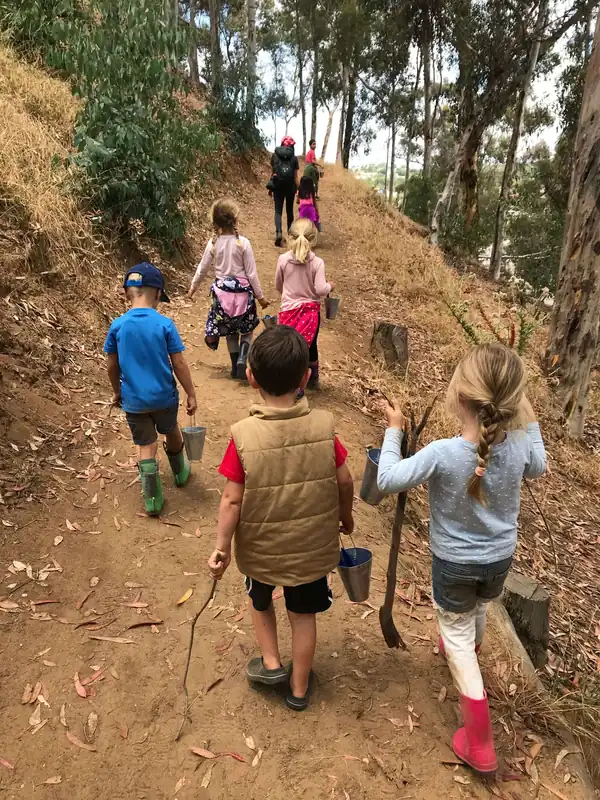
Finland is now encouraging parents to take their toddlers to the forest, according to a Finnish news site.
For those of us who believe children belong outside, this feels less like breaking news and more like a giant Nordic nod of approval.
A new guidebook from South-Eastern Finland University of Applied Sciences encourages families to spend more time in nature during pregnancy, babyhood, and the toddler years. The guide explains that early nature exposure can support children’s immune systems, motor skills, emotional wellbeing, social development, and learning. It also reminds families that nature does not have to mean a grand expedition. A local park, forest path, garden, trail, or natural space can become part of everyday family life.
Here in coastal North County San Diego, this time of year may look a little different from Finland’s forests.
Our summer version of nature is often sandy toes, salty hair, creek splashing, sunscreen negotiations, camp backpacks, and tired children melting into car seats after a full day outside.
But the message is the same: Children need more than occasional outdoor time.
They need nature immersion.
Not just a half hour here and there. Not just recess. Not just a quick “go run around” before returning to the real work indoors.
Nature is the classroom, where children move, wonder, regulate, test boundaries, solve problems, develop confidence, and build a lifelong relationship with the living world.
That is the heart of the Scandinavian forest school model.
And it is the model Nature Scouts Collective is built on.
What Is the Scandinavian Forest School Model?
The Scandinavian forest school tradition is rooted in a simple but powerful idea: children learn best when they are given time, space, freedom, and trust in natural environments.
In Denmark, Sweden, Norway, and Finland, outdoor learning is not treated as a cute add-on. It is woven into early childhood culture.
Children spend long stretches of time outside in all kinds of weather. They climb logs, balance on rocks, inspect insects, build shelters, dig in mud, collect leaves, carry sticks, listen to birds, notice seasonal changes, and learn through direct experience.
The adult’s role is not to over-direct every moment. It is to observe, guide, keep children safe, and support discovery.
In Denmark, forest kindergartens have become a recognized part of early childhood education. UNESCO has described Danish forest schools as places where children spend much of their time in the forest, discovering insects, observing seasonal changes, learning about natural cycles, and developing curiosity, teamwork, and confidence.
In Norway, the cultural idea of friluftsliv, often translated as “open-air life” or “free-air life,” reflects the belief that outdoor life is part of wellbeing, identity, and childhood. Norwegian preschoolers are regularly introduced to hiking and outdoor routines at a young age, and outdoor activity is deeply embedded in family and school culture.
In Sweden, the phrase “rain or shine” is more than a cute saying. It reflects a practical mindset: children can be outdoors in many kinds of weather when they have appropriate clothing, preparation, and adults who believe outdoor life matters.
This is not about being extreme.
It is about making nature normal.
The San Diego Version Is Much Easier
Now, let’s pause for a little climate comparison.
Norwegian winter: snow, ice, freezing rain, heavy gear, wool layers, waterproof suits, mittens that mysteriously disappear, and toddlers who somehow still want to pick up every stick.
San Diego winter: someone says, “It’s freezing,” and it is 58 degrees.
Scandinavian families send children outdoors through weather that would make many Southern Californians cancel plans, pour another coffee, and declare it an indoor day.
Here in coastal North County San Diego, our “harsh conditions” are usually marine layer, damp shoes, a windy beach morning, a muddy trail after rain, or a child who insists on bringing half the sandbox home in their socks.
In other words, we have an incredible advantage.
If Scandinavian forest schools can make outdoor learning work through long, dark, cold seasons, we can absolutely make it work here.
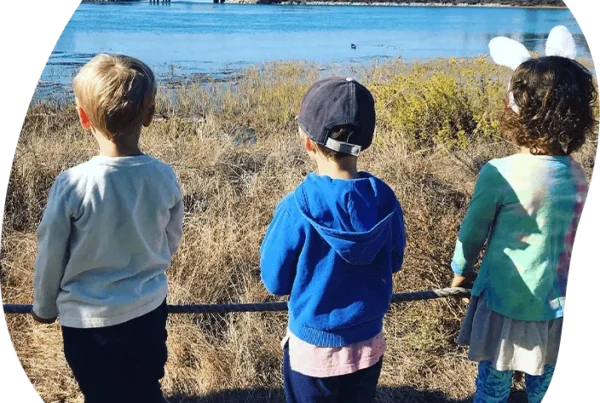
We have beaches, lagoons, trails, eucalyptus groves, coastal bluffs, creeks, open fields, mud after winter rain, wildflowers in spring, and sunshine most of the year.
The Scandinavian model gives us the philosophy.
San Diego gives us the classroom.
Why Nature Immersion Matters More Than “Outdoor Time”
There is a big difference between a short outdoor break and true nature immersion.
A short outdoor break can be helpful. Children need fresh air and movement.
But nature immersion goes deeper.
Nature immersion gives children enough time to settle into the landscape. At first, they may run, shout, or bounce from one thing to another. But after a while, something shifts.
They notice, slow down and begin to look under logs, follow ants, compare rocks, test balance, invent games, negotiate roles, ask questions, build forts, return to the same tree, and create meaning from the place around them.
That kind of learning cannot be rushed.
It comes from repeated, unhurried contact with the natural world.
The Finnish guide makes this same point. It explains that when outdoor activities and time in nature become part of a family’s everyday routine, the positive effects can support long-term wellbeing. It also emphasizes that nature offers a multisensory environment for play, learning, movement, creativity, social development, and emotional regulation.
This is why Nature Scouts Collective is not built around quick outdoor exposure, but rather around immersion.
Children need enough time outside for nature to become familiar, not novel.
They need enough time to move past “What are we doing?” and into “Look what I found.”
What Moms Can Take Away From the Scandinavian Model
The Scandinavian forest school model offers a beautiful reminder for modern parents, especially moms who feel pressure to optimize every part of childhood.
Here are a few takeaways worth holding onto.
1. Outdoor play is not wasted time.
When children are climbing, digging, balancing, collecting, building, or pretending, they are not “just playing.”
They are developing coordination, strength, problem-solving, language, social confidence, creativity, and emotional resilience.
A fallen branch can become a bridge, a horse, a fishing pole, a boundary line, or part of a pretend campfire.
That is not a lack of structure.
That is imagination at work.
2. Children do not need constant adult entertainment.
Forest school models give children room to initiate their own play.
This can feel uncomfortable at first in a culture where adults are often expected to provide activities, instructions, crafts, schedules, and outcomes.
But children grow when they are trusted with time and space.
They learn how to begin, cooperate, and how to be bored for three minutes and then turn boredom into a game.
Those are critical life skills.
3. Risk is not the enemy.
Scandinavian outdoor learning often allows children to engage with appropriate, manageable risk.
Balancing on a log. Climbing a low tree. Scrambling over uneven ground. Carrying a big stick safely. Testing whether a rock is slippery.
These experiences help children learn judgment.
Of course, adults are nearby. Safety matters. But the goal is not to remove every challenge.
The goal is to help children build awareness, confidence, and competence.
4. Weather does not have to cancel childhood.
This may be one of the biggest lessons from Scandinavia.
Children can be outdoors in a wide range of conditions when adults plan well, dress them appropriately, and approach weather as part of the experience rather than an interruption.
In San Diego, this is especially doable.
A little fog, drizzle, wind, damp ground, or cloudy sky does not have to mean the day is ruined.
Sometimes those are the best nature days.
Snails appear. Mud becomes workable. Leaves smell stronger. The trail changes. Children notice things they would miss on a perfect sunny afternoon.
5. Nature helps children feel connected.
The Finnish guide emphasizes that a child’s relationship with nature begins in early childhood and that regular positive nature experiences help children see nature as a meaningful part of everyday life.
Children are more likely to care about what they know and are more likely to protect what they love.
And they are more likely to love what they have touched, smelled, climbed, listened to, splashed in, and returned to again and again.
Nature Scouts Collective Is Built on This Model
Nature Scouts Collective is rooted in the same core beliefs that guide Scandinavian forest schools:
Children belong outside.
Learning happens through play.
Nature is the best teacher.
Confidence grows through real experience.
Community forms when children explore together.
Our programs are designed around outdoor, child-led, sensory-rich, nature-based learning for children in coastal North County San Diego.
That means children are not simply taken outside for a short break from indoor instruction.
The outdoor environment is the foundation.
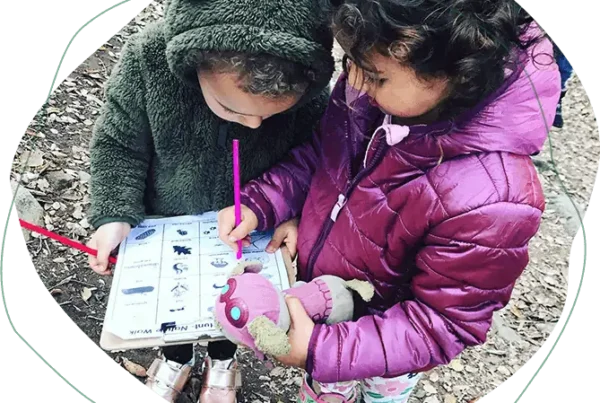
The trail, tree, hill, sand, creek, stone, leaf, shell, bug, bird call, breeze, and changing season all become part of the curriculum.
This is especially powerful for children because nature does not separate learning into neat little boxes.
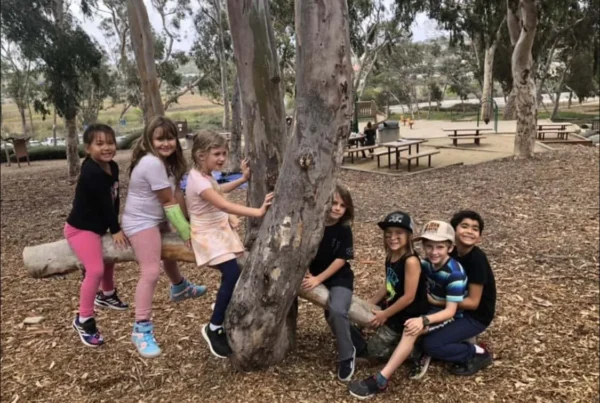
Consider the child balancing on a log is working on coordination, focus, risk assessment, and confidence.
Or the child building with sticks is exploring design, cooperation, spatial reasoning, and imagination.
As for the child noticing a beetle? They are practicing observation, patience, language, and empathy.
This is whole-child learning and exactly what young children need more of.
Nature Scouts Collective: Bringing the Forest School Model to North County San Diego Kids
Nature Scouts Collective is one of North County San Diego’s longest-running nature enrichment programs. Contact me with any questions about the San Diego home school community.