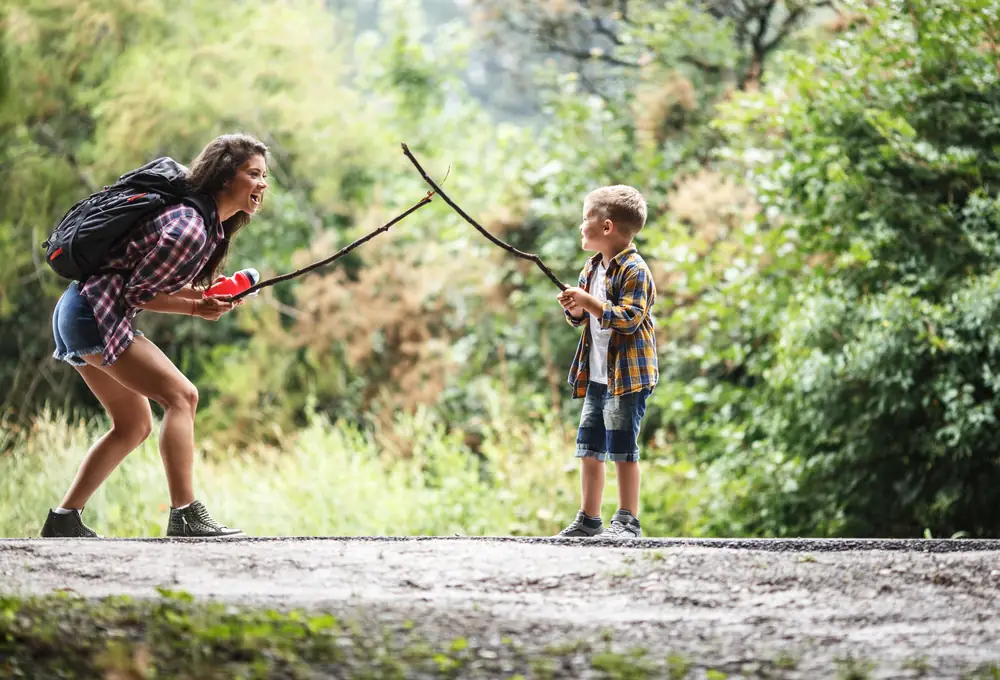
Boys and sticks go together like peanut butter and jelly. Like milk and cookies.
Put a boy in the woods and within minutes he’s holding a stick. Before long, that stick becomes a sword, a bow or blaster (an outdoor play euphemism for toy gun).
For moms who believe that compassion, empathy,and emotional intelligence should always be emphasized, weapons play raises red flags. Aren’t we trying to raise gentle boys? Isn’t symbolic weapon play outdated, aggressive or socially regressive?
It’s a fair concern. At first glance, it seems intuitive that a child who gravitates toward weapon-themed play might be more likely to become aggressive later. Many parents quietly wonder if it’s a warning sign?
Before answering that, let’s ground ourselves in what truly matters.
Every homeschool mama I know is intentionally cultivating:
-
Kindness
-
Emotional regulation
-
Respect for others’ space
-
Non-violence
Those are non-negotiables.
The question isn’t whether those values matter. Of course they do! The question is whether suppressing symbolic weapon play actually strengthens them or unintentionally interferes with healthy development.
What the Long-Term Research Shows About Rough Play
A 2018 study published in Criminal Behaviour & Mental Health followed 2,019 children beginning at age 5 and conducted follow-ups at age 15. This type of research is called a longitudinal study, meaning researchers track the same children over many years to determine whether early behaviors predict later outcomes.
The researchers specifically examined whether early toy weapon play predicted juvenile criminal behavior. They used advanced statistical models to control for other variables known to influence delinquency, including:
-
Early childhood aggression
-
ADHD symptoms
-
Depression symptoms
-
Gender
The findings were unambiguous that toy weapon play in early childhood did not significantly predict later criminality. Even when accounting for behavioral and psychological factors, pretend weapon play showed no meaningful relationship to juvenile crime.
The authors concluded that pretending to be aggressive in childhood plays little role in predicting later criminal behavior once other variables are considered. Involvement in imaginative toy gun use is unlikely to serve as a reliable marker for future delinquency.
In other words, the stick is not the predictor.
What Professional Educators and Child Development Experts Say
This isn’t just one isolated study.
Dr. Peter Gray, research professor at Boston College and author of Free to Learn, argues that rough-and-tumble and combat-themed play often help children develop self-control. In order for play fighting to continue, children must constantly monitor one another’s comfort levels. If someone is upset, the game stops. That dynamic requires empathy, restraint and emotional attunement.
Dr. Anthony Pellegrini, a leading researcher on rough play [PDF chapter link], found that when rough-and-tumble play is mutual and consensual, it is associated with improved social competence; not increased aggression.
Neuroscientist Dr. Jaak Panksepp, who studied the brain’s emotional systems, described play as biologically essential. In animal studies, mammals deprived of rough play showed poorer impulse control and social regulation later on. Play, in his research, was rehearsal for emotional balance.
Even veteran kindergarten teacher and author Vivian Paley wrote extensively about the tension educators feel around “war play.” After attempting to ban it in her classroom, she ultimately observed that children still needed to explore themes of power, protection, and heroism, and that thoughtful guidance was more effective than prohibition.
The common thread across disciplines is that symbolic aggression in imaginative play is not the same as real-world aggression. In fact, it can be one of the safest arenas for learning how to regulate it. This is why martial arts disciplines such as jiu-jitsu are highly effective for regulating otherwise unchecked aggression, not only in boys but girls as well.
What Happens When Symbolic Weapon Play Is Banned?
When symbolic weapon play is automatically labeled as inappropriate or shameful, several unintended consequences can follow:
-
Children may internalize normal impulses as “bad.”
-
Opportunities to practice emotional regulation shrink.
-
Power dynamics get pushed underground instead of negotiated openly.
-
Boys may struggle to integrate assertiveness with empathy.
The instinct toward power-themed storytelling does not disappear simply because adults disapprove of it. It either becomes guided and integrated, or suppressed and unmanaged.
What About Real-World Violence?
The heartbreaking reality of firearm violence is undeniable. But serious violence is consistently associated with factors such as:
-
Severe mental health crises
-
Trauma exposure
-
Social isolation
-
Substance abuse
-
Access to lethal weapons
There is no credible body of research demonstrating that early pretend weapon play is a primary driver of later violent crime.
Conflating symbolic play with criminal behavior oversimplifies a deeply complex issue.
How Nature Scouts Collective Approaches It
At Nature Scouts Collective, we do not promote aggressive behavior. We do not tolerate bullying. We do not allow children to target one another.
What we do allow is imaginative, cooperative storytelling in nature with clear boundaries.
Children are taught to:
-
Ask before engaging in physical play.
-
Stop immediately when someone says stop.
-
Respect personal space.
-
Repair relationships if boundaries are crossed.
-
Balance strength with kindness.
In the woods, what begins as a “weapon” often evolves into a collaborative adventure narrative; boys learn to regulate aggressive behavior.
To reiterate, the problem is not the stick. Rather, the underlying factor in unwanted, unregulated aggressive behavior is guidance (or lack thereof).
Strength and Empathy Can Coexist
Raising compassionate boys does not require eliminating play weaponry. Boys can continue to be boys so long as parents and educators integrate strength with empathy, excitement with restraint and courage with responsibility. And that’s exactly what we do at Nature Scouts Collective.
When guided well, imaginative weapon play is not a red flag. It is rehearsal and a safe space where boys practice being powerful without being harmful.
If you’re looking for a Forest School–inspired homeschool enrichment program that is safe, structured, charter-funded, and developmentally informed, you’ve discovered the right place.